
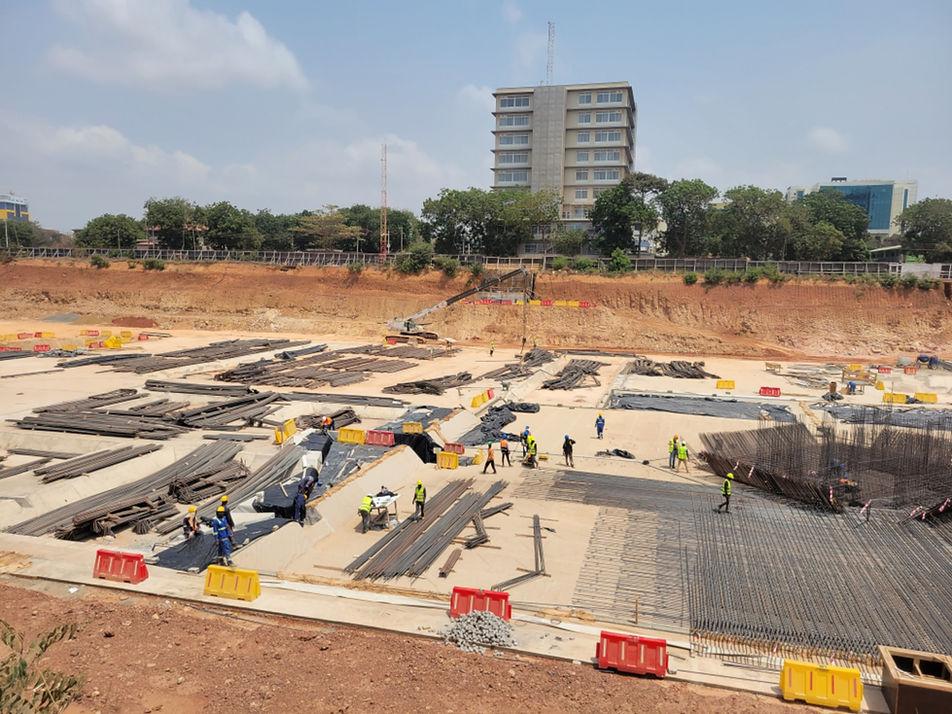

President John Mahama has renewed his opposition to the use of public funds to complete Ghana’s stalled National Cathedral, insisting that the Christian community has sufficient capacity to finance the project if its members collectively contribute towards it.
Speaking during a citizens’ engagement in Wa as part of his tour of the Upper West Region, President Mahama argued that a contribution of GH¢1,000 from each Christian in Ghana could generate substantial resources towards the construction of the facility. His position comes at a time when the Christian Council of Ghana has established a technical committee to examine how the long delayed project could potentially be revived.

President Mahama made clear that his objection was not directed at the idea of constructing a National Cathedral itself, but rather at the use of taxpayers’ resources to finance what he regards as a religious project that should principally be supported by the Christian community.

He argued that Ghana’s sizeable Christian population, together with Christian organisations and supporters outside the country, could mobilise the necessary resources without placing an additional financial burden on the state.

According to the President, a collective contribution of GH¢1,000 from Christians would provide a realistic basis for raising the resources required to advance the project.
He maintained that Christians should therefore assume primary responsibility for mobilising the funding necessary to complete the proposed facility rather than expecting government to commit additional public revenue to its construction.

President Mahama also reiterated his longstanding reservations about the location selected for the project, arguing that the proposed site is already surrounded by several important national institutions and public facilities.
He identified Parliament, the International Conference Centre, the Greater Accra Regional Hospital and the National Theatre among the major establishments located within the vicinity.

In his assessment, placing another major facility within the same area could create substantial congestion, particularly during major national ceremonies and public gatherings when the surrounding institutions and venues already experience intense pressure.

The President explained that his concern about the location had consistently formed part of his reservations about the project and that the concentration of major national facilities within the area could make the site increasingly difficult to manage.
He also criticised the scale of demolition and displacement that preceded the development of the cathedral site.
President Mahama said several properties were destroyed to clear the area, including the residences of 10 judges, the residence of the Malian Ambassador and the former passport office.
He expressed concern that the residence of the Malian Ambassador had still not been replaced, describing the destruction of those properties as another significant problem associated with the project.
Despite his reservations, President Mahama stressed that his position should not be misconstrued as hostility towards the establishment of a National Cathedral.
He emphasised that he is a Christian and has no objection to Ghana having a National Cathedral, but believes that the project must be approached differently, particularly with respect to its financing, location and accountability.
The President has also disclosed that a forensic audit into expenditure on the project has been completed and is currently with the Attorney General.
He said the audit would be made available to the Christian Council of Ghana so that its leadership could scrutinise how almost US$90 million had been spent and determine whether any corrective measures were required.
President Mahama said the findings should enable the government and Christian leaders to establish what happened to the funds already committed to the project and, where necessary, agree on appropriate measures to address any problems identified.
His comments have added fresh momentum to the increasingly important debate over the future of the National Cathedral, particularly because the Christian Council of Ghana has only recently initiated its own process to determine whether and how the stalled project can be revived.
The Council announced on September 11 that it had constituted a technical committee made up of representatives from various Christian groupings to examine the outstanding issues surrounding the project.
The committee has been given one month to formulate a practical financing arrangement, consider the proposed location and address other unresolved matters connected with the project.
The Council is expected to submit its findings and recommendations to the Minister for Local Government, Chieftaincy and Religious Affairs, Mahama Ayariga, after which the recommendations are expected to be forwarded to President Mahama to guide decisions on the future of the project.
The Christian Council has also called for the findings of the forensic audit to be made available to Christian leaders so that they can properly understand the financial and administrative issues surrounding the project before determining the way forward.
President Mahama has further distinguished the National Cathedral from other projects and policies inherited from the previous administration that his government has chosen to continue.
He explained that although his administration has generally sought to preserve projects and policies considered to be in the national interest, he does not regard the National Cathedral as falling within that category.
According to him, the cathedral project originated from a personal pledge made by former President Nana Addo Dankwa Akufo Addo to God and was therefore not a government policy that automatically binds a subsequent administration.
The President’s latest comments therefore place the responsibility for determining the future of the project increasingly in the hands of the Christian community, while the government maintains its position that no additional taxpayer resources should be committed to its construction.
The development also creates a potentially significant test for the newly established Christian Council technical committee, which must now consider not only how the project could be financed without public funds, but also whether its proposed location remains appropriate and how the concerns surrounding the expenditure already incurred can be addressed.
With the committee expected to present its recommendations within one month, the future of Ghana’s unfinished National Cathedral is once again at the centre of a national discussion involving government, Christian leaders and the wider public.

