
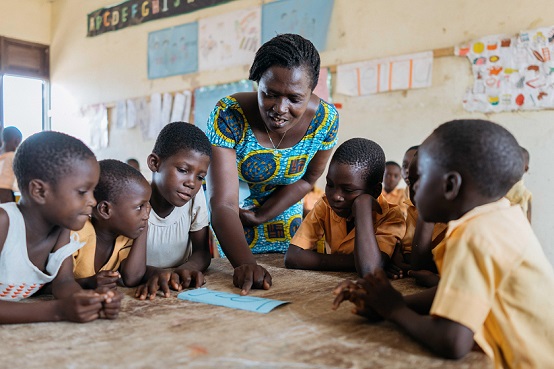

Teachers and headteachers in some basic schools across Ghana are being compelled to spend portions of their personal salaries to keep classrooms functioning, amid what the Ghana National Association of Teachers says is a persistent shortage of financial resources for foundational education.
The General Secretary of the Ghana National Association of Teachers, Thomas Musah, says educators at the kindergarten, primary and junior high school levels are increasingly using their own money to purchase essential materials and meet immediate school needs because funding allocated to basic education remains inadequate.

Speaking on Eyewitness News on Monday, September 7, 2026, Mr Musah said the situation had become a serious indication of the financial pressures confronting basic schools, with teachers and heads sometimes having little choice but to personally finance activities that should ordinarily be supported through public education funding.

He explained that some teachers and headteachers were effectively investing their own earnings into the schools in order to prevent shortages from disrupting lessons and other academic activities.

According to Mr Musah, the problem extends beyond individual schools and reflects what he considers to be a broader imbalance in the distribution of resources within Ghana’s education system.
He claimed that only about nine percent of the Ministry of Education’s budget is allocated to basic education, while approximately 62 percent goes towards senior high school education. He argued that the disparity deserves serious examination because basic education provides the academic foundation upon which every subsequent level of learning depends.

Mr Musah attributed part of the imbalance to the political attention surrounding senior high school education, arguing that successive administrations have placed considerable emphasis on the sector because of its strong political significance.
He described senior high school education as having become a political instrument, noting that both the National Democratic Congress and the New Patriotic Party have placed considerable emphasis on providing resources for second cycle education.

However, he maintained that political visibility should not come at the expense of the foundational stages of schooling, where children acquire the literacy, numeracy, discipline and learning habits required to succeed later in their education.

His concerns come at a time when Ghana’s education system is facing renewed questions about the preparedness of children completing basic education for the transition into senior high school.
Figures released by the Computerised School Selection and Placement System Secretariat indicate that approximately 565,000 of the nearly 620,000 candidates who sat the 2026 Basic Education Certificate Examination met the requirements for placement into senior high and senior high technical schools. This means that roughly 55,000 candidates did not satisfy the stated placement requirements.
The placement figures have generated fresh discussion about the quality of foundational education and whether adequate resources are reaching schools where children spend their formative years.
Mr Musah believes the development should prompt policymakers to look beyond placement statistics and examine the circumstances under which pupils are being taught, particularly in schools where teachers and headteachers are reportedly compelled to finance basic necessities from their own pockets.
He consequently called for closer attention to the adequacy and regular release of capitation grants, arguing that schools cannot be expected to deliver strong learning outcomes when resources required for routine academic activities are insufficient or delayed.
He also identified inadequate infrastructure as another longstanding difficulty confronting basic education, saying the shortage of suitable classrooms and other essential facilities continues to undermine efforts to provide children with an effective learning environment.
The concerns raised by GNAT come against the backdrop of broader evidence that Ghana continues to face significant challenges in foundational learning. UNICEF Ghana has reported that a substantial proportion of children do not acquire basic literacy and numeracy skills by the end of primary school, reinforcing calls for stronger investment in the early stages of education.
For Mr Musah, the solution requires a deliberate shift towards treating basic education as a national priority rather than allowing attention and resources to become concentrated around senior high school education.
He argued that investment at the foundational level would not only improve classroom conditions but could also strengthen pupils’ academic performance before they reach the stage where placement into second cycle institutions becomes a major concern.
The GNAT General Secretary therefore urged the government, education authorities and other stakeholders to reassess the distribution of resources across the education sector and ensure that basic schools receive adequate and timely financial support.
He stressed that teachers should not have to sacrifice their salaries to provide the materials required for children to learn, insisting that the responsibility for financing public education must rest principally with the state and not individual educators.
The emerging concern, therefore, is not simply how many pupils successfully secure senior high school placement, but whether Ghana is providing sufficient resources at the basic level to give every child a realistic opportunity to reach that stage adequately prepared.
For a system seeking to improve educational outcomes, Mr Musah’s warning presents a fundamental question: how can Ghana expect stronger results from its children when some of the teachers responsible for laying their educational foundation are reportedly paying out of their own pockets to keep schools operating?

