
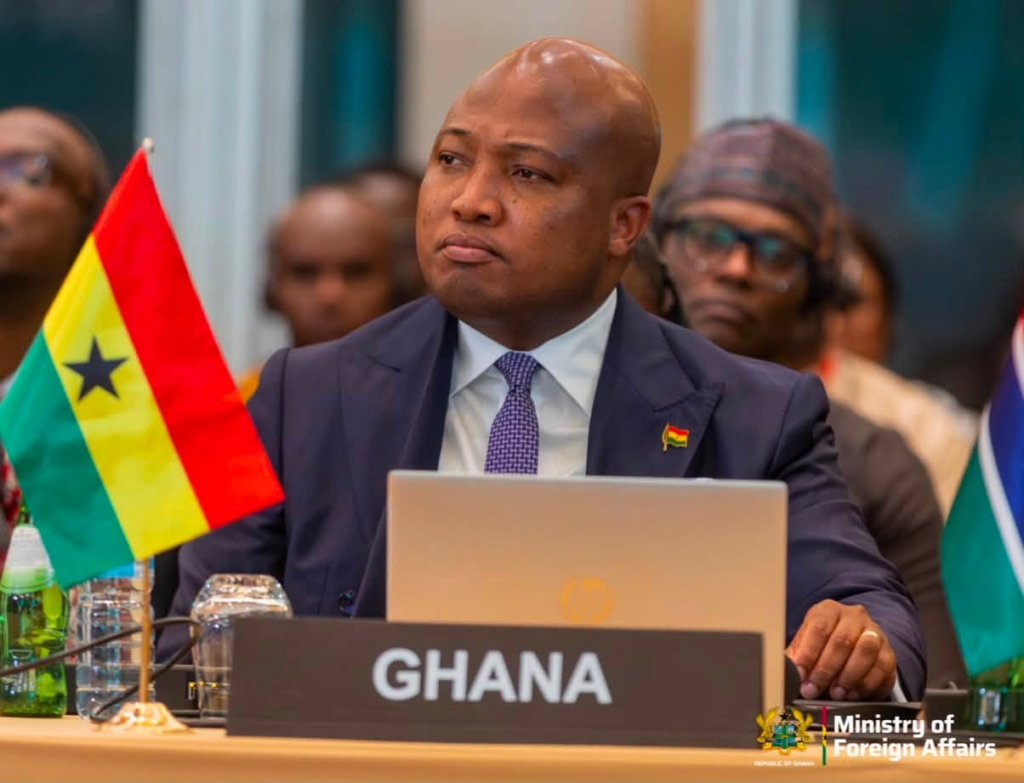

Ghana’s Minister for Foreign Affairs, Samuel Okudzeto Ablakwa, has appealed to African leaders to undertake a sincere examination of the underlying factors responsible for the continent’s persistent conflicts and insecurity, insisting that Africa can no longer afford to treat violence, extremism and humanitarian crises as normal features of its political landscape.
Mr Ablakwa made the appeal during the African Union Executive Council’s extraordinary deliberations on conflict prevention and resolution in Luanda, Angola, where African leaders and senior officials are considering practical measures to strengthen the continent’s capacity to prevent, manage and ultimately resolve conflicts. The meeting is focused on developing more effective continental mechanisms for peace and security.

The Ghanaian Foreign Affairs Minister maintained that African governments must undertake what he described as a genuine and courageous examination of the circumstances that continue to generate instability across the continent. He argued that the time had come to abandon the tendency to merely respond to conflicts after they had erupted and instead confront the conditions that allow violence and extremism to take root.

According to Mr Ablakwa, Africa is rapidly losing valuable time in its pursuit of a transformed continent, making it imperative for political leaders to adopt decisive measures that address the structural weaknesses undermining peace, prosperity and social stability.

He identified several factors that continue to contribute to conflict across Africa, including injustice, limited economic prospects for young people, persistent underdevelopment, corruption, exploitation of natural resources, intolerance, political insincerity and the involvement of African countries in proxy struggles involving external interests.
Mr Ablakwa argued that these underlying challenges must receive greater attention if the continent is to establish sustainable peace. In his view, simply negotiating temporary settlements between conflicting parties without addressing the circumstances that generated those disputes in the first place would leave Africa vulnerable to repeated cycles of violence.

He further drew attention to the increasing desperation among young Africans who continue to search for economic opportunities outside the continent, describing the phenomenon as a powerful indication that governments must reconsider their development priorities.
Referencing the recent migration crisis involving Ceuta, the Spanish territory bordering Morocco, Mr Ablakwa said reports that more than 72,000 people attempted to cross into the territory should serve as a serious warning to African policymakers. He also noted reports that 111 people lost their lives during the episode, arguing that such developments demonstrate the urgency of creating conditions under which young Africans can envision a viable future within their own countries.

The Minister consequently called for a fundamental redirection of national and continental resources, arguing that governments should place greater emphasis on employment creation, industrial expansion and economic opportunity rather than allowing resources to be consumed by prolonged conflicts.

He said African countries must recommit themselves to creating decent employment, expanding industrial capacity, distributing the benefits of the continent’s natural wealth more equitably and strengthening economic opportunities for the rapidly growing youth population.
Mr Ablakwa also pointed to the broader developmental challenges confronting millions of Africans, including limited access to electricity, insufficient employment opportunities and dangerous migration routes. He cited International Organization for Migration figures indicating that more than 2,180 young Africans died in the Mediterranean during the previous year while attempting to reach what they considered better economic prospects.
He therefore maintained that peace and security policies cannot be separated from economic development, social justice and political inclusion. In his assessment, genuine stability will remain difficult to achieve if governments fail to address the poverty, inequality, unemployment and exclusion that can make vulnerable populations susceptible to recruitment by extremist organisations or compel young people to undertake perilous journeys abroad.
The Foreign Affairs Minister urged African leaders to move beyond the conventional practice of managing conflicts after they emerge and instead concentrate on eliminating the conditions that produce them. He said investment in education, employment, industrialisation, infrastructure and equitable access to national resources should form an integral part of Africa’s long term peace and security strategy.
His intervention comes as the African Union intensifies discussions on strengthening its continental mechanisms for conflict prevention and resolution, with the extraordinary session in Luanda expected to produce practical measures aimed at improving coordination, implementation and financing for African peace and security initiatives.
Mr Ablakwa’s central message was that Africa’s pursuit of lasting peace requires a fundamental change in priorities. Rather than continuously allocating resources to confront the consequences of conflict, he believes governments must invest substantially in eliminating the economic, political and social conditions that allow instability to persist.
He consequently called on African leaders to embrace a new approach centred on employment, industrialisation, responsible governance, equitable development and meaningful opportunities for young people, arguing that a safer and more prosperous continent will ultimately depend on the ability of its governments to give their citizens compelling reasons to build their futures at home.

