
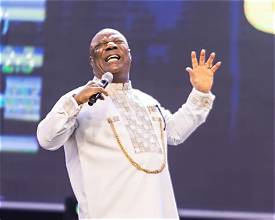

Self-proclaimed Archbishop and Founder and the General Overseer of Action Chapel International, Mr. Nicholas
Duncan-Williams has waded into the internecine war between the parliamentary faction of the New Patriotic Party
(NPP), and Sammi Gyamfi, the Chief Executive Officer of the Ghana Gold Board (GOLDBOD).
In a sermon at his pulpit on Sunday, Mr. Duncan-Williams created the impression that some elements were working
to undermine lawful attempts to improve revenue for the country.
According to him, the information that caused his concern was based on information he received from a ‘Sheikh ’.
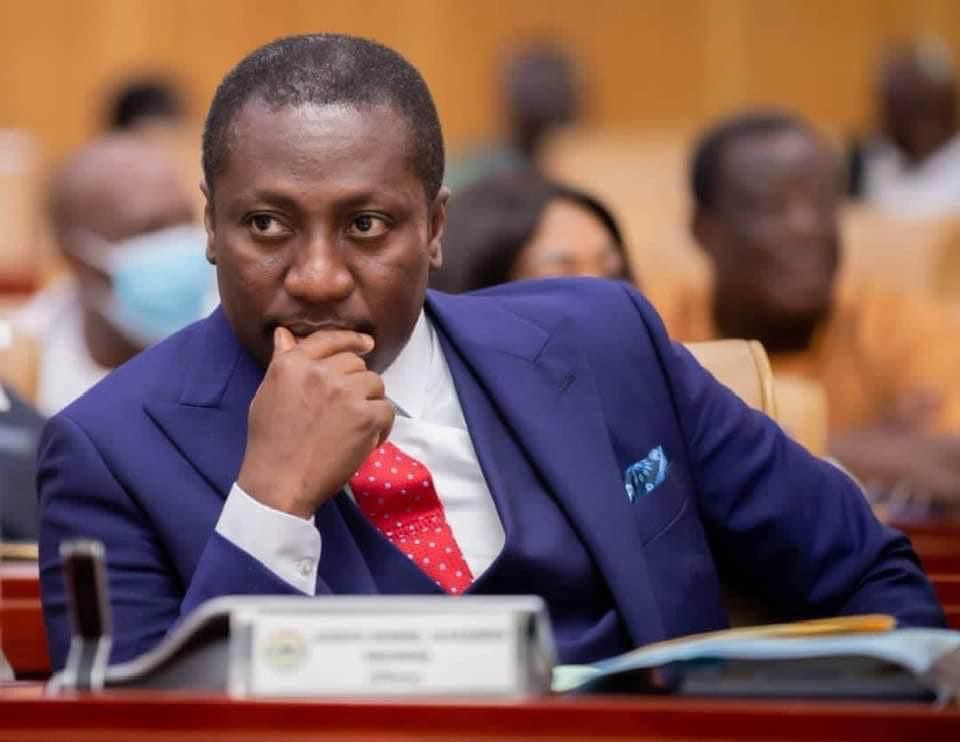
 Speaking during a church service on Sunday, August 16, Duncan-Williams said he was reminded of a conversation
he had with a Sheikh, who allegedly disclosed that the amount of illegal gold purchased by some buyers exceeded
the volume of gold officially recorded by Ghana.
According to him, the buyers had documentation of the transactions, while Ghana did not have corresponding
records.
“The amount of illegal gold that they bought and they had records of it, but Ghana didn’t have a record of it,”
Duncan-Williams said.
He explained that the gold Ghana had records of was largely what the government had officially sold, while there
was another volume of gold for which, he claimed, Ghana had no corresponding records.
“The one Ghana has record of was what the government sold, but the one Ghana didn’t have record of was more
than what Ghana sold to them. And they have all the record and we don’t,” he said.
Duncan-Williams said the situation raised questions about the effectiveness of Ghana’s laws and regulatory systems,
particularly in relation to illegal mining and the gold trade.
He argued that the problem was compounded when efforts to enforce the law became politicised.
“For whatever reason, it looks like the rules and the laws are not working because if anybody tries to make it work
and enforce the law, we turn everything to politics,” he said.
According to him, political considerations could discourage lawmakers and political leaders from taking firm action
against illegal activities.
He cited the fear of losing electoral support as one of the factors that could influence political decisions.
“If you don’t do what I want, next time I won’t vote for you,” he said, describing the pressure politicians may face
from constituents.
Duncan-Williams suggested that concerns about losing parliamentary seats or political power could ultimately
contribute to a situation where lawlessness is tolerated.
He urged Ghanaians to take the situation seriously and dedicate time to praying for the country, particularly over
issues that could affect future generations.
Mr. Duncan-Williams comments comes at a time when Sammi Gyamfi, who is a deeply political individual as the
former Director of Communications of the ruling National Democratic Congress (NDC) is engaged in a highly
public wrangling debate with the Minority in parliament. The background to that disagreement is however more
complex than a remote and unreported and unverifiable ‘conversation with a mystery Shiek’ as Mr. Duncan-
Williams will have Ghanaians believe.
Historical account of the impasse
1. The dispute began before GoldBod formally came into existence
The roots of the confrontation go back to the GoldBod Bill debate in March 2025.
Sammy Gyamfi was then Acting Managing Director of the Precious Minerals Marketing Company (PMMC) and
was closely associated with the government's effort to transform PMMC into GoldBod. The proposed institution was
intended to become the principal state vehicle for purchasing, aggregating, assaying and exporting gold from
Ghana's small-scale mining sector.
Gyamfi maintained that the Bill had undergone extensive consultations with miners, dealers and other stakeholders.
The Ghana News Agency reported on March 3, 2025 that he said the draft had already received approval from the
Ministries of Finance and Lands and Natural Resources and the Attorney-General's Office.
The NPP Minority did not oppose the concept of GoldBod outright. Indeed, Gyamfi himself subsequently
acknowledged that the Minority's position, led at the technical stage by former Finance Minister Mohammed Amin
Adam, was that it supported the establishment of GoldBod but wanted amendments to make the legislation fit for
purpose.
The disagreement was therefore initially about how GoldBod should be established and empowered, rather than
whether it should exist.
2. The March 2025 parliamentary confrontation
The relationship deteriorated sharply during consideration of the Bill.
According to Gyamfi's account, the NPP side submitted more than 50 advertised amendments and subsequently
raised more than 20 additional proposals during the winnowing process. He said the amendments were discussed
extensively and that several were accepted. He also stressed that the winnowing process was attended by Minority
Leader Alexander Afenyo-Markin.
The Minority nevertheless accused the Majority of rushing the legislation through Parliament.
The disagreement culminated in the parliamentary controversy of March 28, 2025. Afenyo-Markin held a press
conference and, according to Gyamfi's subsequent response, labelled the proposed institution a “Galamsey Board.”
Gyamfi regarded the description as a partisan attack and insisted that the Bill had received extensive parliamentary
scrutiny.
Parliament subsequently passed the Bill on March 28, 2025. The GoldBod itself records that the legislation
established the Ghana Gold Board with responsibility for overseeing, monitoring and undertaking the buying, selling
and export of gold and other precious minerals, with GoldBod becoming the sole exporter of gold from the small-
scale mining sector.
The President assented to the legislation, creating the statutory Ghana Gold Board under the Ghana Gold Board Act,
2025 (Act 1140). The new institution consequently became much more than a policy proposal: it became a powerful
statutory body with extensive control over Ghana's small-scale gold-trading chain.
That concentration of regulatory and commercial power would subsequently become one of the Minority's major
areas of concern.
3. The Nana Agradaa dollar controversy transformed the disagreement
The confrontation moved from institutional policy to the conduct of Sammy Gyamfi himself in May 2025.
A video circulated showing Gyamfi giving US dollar notes to Patricia Oduro Koranteng, popularly known as Nana
Agradaa. The Minority seized upon the incident and demanded that President Mahama sack or suspend Gyamfi.
Graphic Online reported on May 13, 2025 that the Minority accused Gyamfi of breaching the President's Code of
Conduct for Political Appointees and alleged that the incident raised questions under Ghana's foreign-exchange
laws. The Minority also called for investigation into the source of the dollars and suggested that the Ghana Revenue
Authority examine whether gift-tax obligations arose.
This was significant because it changed the nature of the confrontation.
The NPP Minority was no longer merely attacking GoldBod policy. It was questioning the personal conduct and
suitability of the man appointed to run the institution.
The controversy became sufficiently serious that the Chief of Staff, Julius Debrah, was reportedly involved and
National Security was said to have been directed to search Gyamfi's residence.
The Minority's demand for Gyamfi's removal did not succeed.
He remained in charge and ultimately became substantive CEO of GoldBod.
4. The licensing controversy
The next significant confrontation concerned GoldBod's licensing arrangements.
By the beginning of 2026, the Minority was questioning how GoldBod had licensed gold aggregators and whether
the system was creating an undue concentration of market power.
One particular controversy concerned Bawa Rock Company Limited.
Citi News reported on January 3, 2026 that Gyamfi rejected concerns raised by the Minority about GoldBod's
licensing system. He explained that Bawa Rock had been the only applicant among 31 applications that met the
eligibility requirements for an aggregator licence during GoldBod's first year. He also stressed that GoldBod
operates a four-tier licensing system comprising Tier One buyers, Tier Two buyers, self-financing aggregators and
aggregators.
This dispute is important because it reveals a recurring feature of the impasse:
the Minority's argument is increasingly centred on transparency, competition and accountability, while Gyamfi's
defence is that the Minority misunderstands the institutional architecture and operational rules of GoldBod.
5. The $214 million Gold-for-Reserves controversy
The confrontation reached a much more consequential stage in December 2025 and January 2026.
An IMF report indicated that the Bank of Ghana had incurred approximately US$214 million in losses under the
Gold-for-Reserves programme. The Minority interpreted the figure as evidence of serious problems in the design
and implementation of the programme and demanded greater transparency and accountability.
Citi News reported on January 8, 2026 that the Minority criticised GoldBod's response to the IMF-related losses,
describing it as lacking transparency. The IMF had identified the losses as a potential downside risk to Ghana's

macroeconomic stabilisation programme and linked them to transactions involving artisanal and small-scale mining
gold and GoldBod off-taker fees.
Gyamfi rejected the interpretation.
He argued that the US$214 million figure related to the Bank of Ghana's Gold-for-Reserves programme and should
not be presented as a loss incurred by GoldBod itself. He maintained that GoldBod had actually generated surpluses.
The distinction is crucial.
The Minority was effectively asking:
What happened to the money under the Gold-for-Reserves arrangement, and why did the programme generate such
a large accounting loss?
Gyamfi's response was essentially:
Do not confuse the Bank of Ghana's accounting position under the programme with GoldBod's own financial
performance.
That difference in interpretation became the central battlefield.
6. Gyamfi counterattacks: “Look at your own record”
Gyamfi did not simply defend GoldBod.
He went on the offensive.
In December 2025, he accused the NPP Minority of hypocrisy and argued that the losses associated with the Gold-
for-Reserves and Gold-for-Oil programmes were not a creation of the Mahama administration.
GBC reported that Gyamfi cited audited losses of approximately GH¢7 billion incurred during 2023 and 2024 under
the previous NPP administration—GH¢2.15 billion in 2023 and GH¢4.84 billion in 2024—under the Gold-for-Oil
and Gold-for-Reserves arrangements.
The political argument therefore became:
Minority: The Mahama government's GoldBod/G4R arrangements have generated enormous losses and require
investigation.
Gyamfi: The programme's problems did not begin with GoldBod; the previous NPP government itself incurred
substantially larger losses under related programmes.
This transformed what began as an accountability question into a classic Ghanaian political contest over who
inherited the problem and who should bear responsibility for it.
7. GoldBod's defence: the programme was never principally about profit
Gyamfi and GoldBod have also challenged the conceptual basis of the Minority's criticism.
GoldBod has maintained that the Artisanal and Small-Scale Mining Gold-for-Reserves programme was not designed
as a profit-making commercial operation.
Its stated objectives include formalising the gold trade, reducing gold smuggling, accumulating foreign exchange
reserves and supporting macroeconomic stability. GoldBod has therefore argued that judging the programme solely
by whether it made a conventional trading profit misses its policy purpose.
Gyamfi has gone further, arguing that even if the US$214 million cost is accepted, the programme generated more
than US$10 billion in foreign-exchange accumulation and therefore should be viewed in the context of its broader
economic benefits.
The Minority, however, has maintained that the magnitude and structure of the losses demand proper scrutiny rather
than being dismissed as the cost of economic policy.
This is probably the substantive heart of the present impasse.
8. The dispute has now moved to GoldBod's own accounts
By July 2026, the argument had evolved again.
The NPP Minority accused GoldBod itself of making losses and mismanaging public funds.
GoldBod rejected the allegation and pointed to its 2025 audited financial statements, claiming an operational surplus
of GH¢909.7 million and an overall surplus of GH¢5.44 billion. Citi News reported on July 24 that GoldBod
described the Minority's claims as inaccurate and politically motivated.
This is a significant development because it means the two sides are now arguing over different financial questions:
losses incurred by the Bank of Ghana under the Gold-for-Reserves programme;
the economics of the Gold-for-Reserves policy itself; and
GoldBod's own audited financial performance.
Those questions are related, but they are not identical.

The danger in the political debate is therefore that the public may hear “US$214 million loss” and “GH¢5.44 billion
surplus” and assume that the two figures are directly contradictory. They do not necessarily measure the same thing.
9. Why the impasse has become personal
There is another dimension that should not be overlooked.
Sammy Gyamfi is not simply a technocrat appointed to administer GoldBod. He was, before his appointment, the
National Communications Officer of the NDC and one of the party's most aggressive public political
communicators.
Consequently, the man defending GoldBod is also a prominent political combatant.
That history colours virtually everything he says about the NPP Minority.
Conversely, the NPP Minority is not merely scrutinising a neutral public servant. It is confronting a prominent NDC
partisan who has spent years attacking the NPP and its governments.
This helps explain why exchanges between Gyamfi and the Minority frequently descend from technical
disagreement into accusations of hypocrisy, misinformation, political mischief and partisan motivation.
The Ghana News Agency reported in January 2026 that a senior NDC cadre had called for protection for Gyamfi
against what he described as attempts by the NPP Minority to intimidate and distract him from performing his duties
as CEO.
That intervention itself demonstrates how politically charged the relationship has become.
10. The impasse in chronological perspective
The history can therefore be reduced to four phases:
Period Principal dispute Minority's position Gyamfi/GoldBod response
March 2025 GoldBod Bill Bill was rushed / concerns over powers

and structure
Extensive consultation and parliamentary
scrutiny

May 2025 Dollar-gift
controversy
Gyamfi should be suspended/sacked;
possible legal and ethical violations Gyamfi remained in office

Late
2025–Jan.
2026

G4R / US$214m Programme suffered serious losses;
transparency required
Loss relates to BoG programme, not
GoldBod; broader macroeconomic
benefits
2026 Licensing and
GoldBod finances
Concerns over monopoly, licensing and
alleged losses
Licensing was rule-based; 2025 audited
accounts show GH¢5.44bn surplus
The dispute has consequently evolved from “Should GoldBod be created?” to “Should Sammy Gyamfi remain in
charge?”, and finally to “Is GoldBod itself operating properly and transparently?”
The deeper issue
The most interesting aspect of this history is that there is a legitimate public-interest issue underneath the political
warfare.
GoldBod has been given extraordinarily significant powers over Ghana's gold economy. Its official description says
it is the only legally authorised body with the power to license persons engaged in trading gold, diamonds and other
precious minerals in Ghana. It also says that, backed by government seed capital of US$279 million, GoldBod
oversees the purchase, assay, refining and export of gold.
An institution with that level of financial and regulatory power inevitably requires exceptionally strong
parliamentary scrutiny, auditing and public accountability.
The NPP Minority is therefore entitled to ask questions.
But equally, GoldBod is entitled to insist that those questions be based on the correct accounting distinctions and
audited information.
The answer should not be another political press conference from either side.
The appropriate response is documentation.
If the Minority believes the Gold-for-Reserves programme lost US$214 million, the public should see the
underlying transactions, accounting treatment, off-taker fees, purchase prices, sale prices and the relationship
between the Bank of Ghana and GoldBod.
If GoldBod says it made GH¢5.44 billion in overall surplus, the audited accounts should be subjected to serious
parliamentary and public examination.
And if the licensing regime is alleged to favour particular companies, the licensing criteria, applications received,
successful applicants and reasons for rejection should be capable of independent verification.
In short, the impasse between Sammy Gyamfi and the NPP Minority has become too important to be left to Sammy
Gyamfi and the NPP Minority.
It is now a question of whether Ghana can create a gold-trading institution powerful enough to influence the
country's foreign-exchange position while maintaining the transparency, independent oversight and institutional
checks necessary to protect the public purse.
That is the real story behind the political quarrel.
And it is considerably bigger than the personalities involved.

