
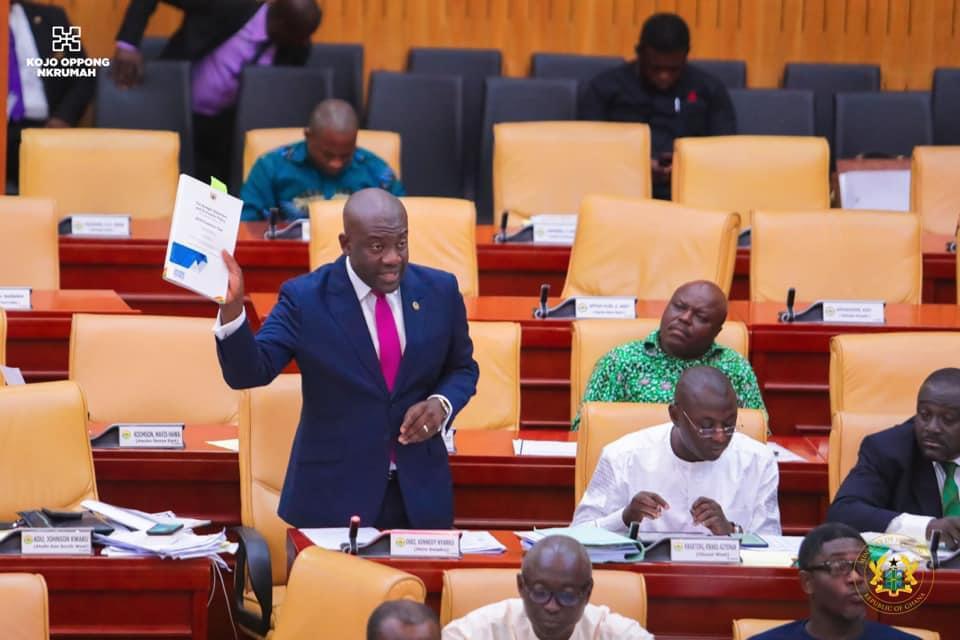

Ranking Member on Parliament’s Economy and Development Committee, Kojo Oppong Nkrumah, has criticised the government for allegedly fast tracking the new cocoa legislation without providing farmers and other important participants across the cocoa industry with sufficient opportunity to contribute to its development.
The Ofoase Ayirebi Member of Parliament argued that the proposed legal framework has implications for numerous stakeholders throughout Ghana’s cocoa value chain and should consequently have been subjected to broader consultation before being finalised.

Speaking on Eyewitness News on Monday, August 10, 2026, Mr Oppong Nkrumah maintained that meaningful engagement with cocoa farmers, transport operators and processors would have enabled lawmakers and policymakers to identify potential difficulties and develop provisions that are more practical and responsive to conditions within the sector.

According to the former Minister for Information, several provisions contained in the legislation have substantial implications for the people and businesses whose activities directly support Ghana’s cocoa industry. He therefore believes their experiences and concerns should have informed the drafting process.

Mr Oppong Nkrumah stressed that the Minority’s reservations should not be interpreted as opposition to the fundamental objectives of the legislation. Instead, he explained that the principal concern relates to the manner in which certain provisions were formulated and the limited opportunity stakeholders had to influence their final content.
He argued that the government could have avoided several of the concerns subsequently raised by the Minority if cocoa industry participants had been given adequate space to examine the proposed measures and offer practical recommendations before the legislation was passed.

The legislator maintained that the Minority broadly supports the underlying intention of strengthening the regulatory framework for Ghana’s cocoa sector but believes that effective legislation must be designed through meaningful engagement with the people expected to operate under its provisions.
Mr Oppong Nkrumah further contended that farmers should have been given the opportunity to explain how particular provisions could affect their livelihoods and suggest adjustments that would make the legislation more workable without undermining the government’s broader policy objectives.

Among the areas he identified for closer consideration are provisions concerning the conversion or repurposing of cocoa farms and arrangements relating to payments to cocoa farmers.

He said the government’s desire to safeguard productive cocoa farms from being converted to alternative uses is understandable, but cautioned that the implementation of such measures must take account of the economic realities confronting farmers.
According to him, legislation designed to protect the cocoa industry should not inadvertently create additional difficulties for farmers whose livelihoods depend on the land or impose requirements that are impractical to enforce.
The Ranking Member argued that a comprehensive consultation process involving farmers, hauliers, processors and other relevant participants would have helped policymakers identify such challenges before the legislation became law.
He further maintained that stakeholder participation is particularly important in an industry as extensive and economically significant as cocoa, where decisions affecting one segment of the value chain can have consequences for numerous other participants.
Mr Oppong Nkrumah therefore urged the government to remain receptive to concerns raised by stakeholders and consider refining aspects of the legislation where necessary.
He said such adjustments would not undermine the objectives of the new cocoa framework but could instead strengthen its effectiveness by ensuring that the provisions are realistic, enforceable and responsive to the conditions prevailing across the sector.
The legislator maintained that the ultimate objective should be to create a regulatory framework capable of protecting Ghana’s cocoa industry while simultaneously safeguarding the interests and livelihoods of the farmers, businesses and other participants whose activities sustain the sector.
He consequently called on the government to carefully consider the concerns emerging from stakeholders and make appropriate improvements where necessary so that the implementation of the legislation produces the intended outcomes without imposing avoidable burdens on the cocoa value chain.

