
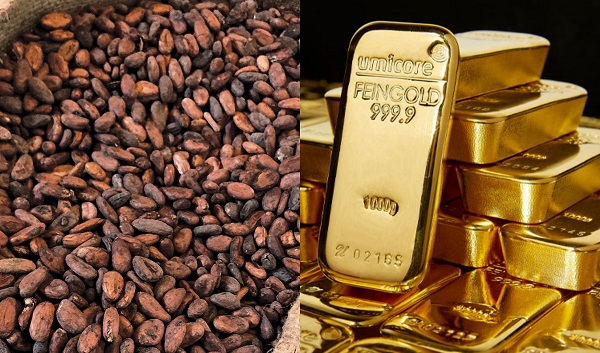

Ghana delivered one of its strongest international trade performances in recent history during 2025 after recording a merchandise trade surplus of GH¢148.3 billion, equivalent to US$11.5 billion, representing more than three times the surplus achieved in the previous year. The remarkable performance, powered principally by soaring gold exports together with resilient commodity shipments and expanding commercial engagement across international markets, underscores Ghana’s strengthening position within global trade despite persistent economic uncertainties and volatile commodity markets.
Fresh data contained in the 2025 Annual International Merchandise Trade Statistics Report published by the Ghana Statistical Service reveal that the country’s external trade reached unprecedented levels during the year, highlighting the growing importance of exports in supporting economic growth, foreign exchange accumulation and macroeconomic stability.

According to the report, the total value of Ghana’s international merchandise trade climbed to GH¢654.7 billion, equivalent to US$52.5 billion. Exports accounted for GH¢401.5 billion, or approximately US$32.0 billion, while imports stood at GH¢253.2 billion, representing US$20.5 billion. The substantial gap between exports and imports produced a trade surplus of GH¢148.3 billion, making 2025 one of the most successful years for Ghana’s external trade sector in decades.

The figures represent a significant milestone for an economy that has worked over recent years to restore fiscal stability, strengthen foreign exchange reserves and improve external sector performance following a period of economic adjustment. The impressive surplus also provides an important source of foreign currency inflows, helping to support the Ghana cedi, strengthen international reserves and improve investor confidence in the country’s broader economic outlook.

Gold once again emerged as the undisputed pillar of Ghana’s export economy, generating GH¢252.4 billion in export earnings and contributing nearly sixty three percent of total merchandise exports. The precious metal maintained its position as the country’s largest foreign exchange earner, reflecting both sustained global demand and robust domestic production.
Alongside gold, cocoa products together with mineral fuels remained the backbone of Ghana’s export portfolio. Collectively, these three commodities accounted for an overwhelming 85.9 percent of all exports during the year, illustrating both the country’s considerable strength in natural resource based exports and its continued dependence upon a relatively narrow range of primary commodities.

While the robust earnings reaffirm Ghana’s competitive advantage in global commodity markets, the report also draws attention to an enduring structural challenge. Despite successive policy efforts aimed at industrialisation, export diversification and value addition, the country’s export sector remains heavily concentrated around raw and semi processed commodities. This concentration leaves export earnings vulnerable to fluctuations in international commodity prices, geopolitical developments and changing global demand.
Beyond export growth, Ghana also expanded its commercial reach across the international marketplace during 2025, demonstrating increasing integration into the global trading system. The country imported merchandise from 216 countries compared with 211 in the previous year, while Ghanaian products reached 163 export destinations, an increase from 155 countries in 2024. The expansion reflects growing market access for Ghanaian goods together with stronger commercial relationships across multiple regions of the world.

Asia retained its position as Ghana’s largest trading partner, reinforcing the continent’s strategic importance within the country’s international commerce. The region continues to serve as a major destination for Ghanaian commodity exports while simultaneously supplying a broad range of manufactured goods, industrial equipment, machinery, consumer products and raw materials essential for domestic production.

Trade relations within Africa also recorded encouraging progress. Ghana maintained a strong surplus in intra African trade, with exports to neighbouring and regional economies exceeding imports from the continent by more than twofold. According to the Ghana Statistical Service, the country generated a trade surplus of GH¢34.7 billion with African trading partners during 2025, reinforcing Ghana’s growing role as a major supplier of goods within the framework of regional economic integration.
The performance is particularly significant in light of the continued implementation of the African Continental Free Trade Area, whose Secretariat is headquartered in Accra. The expanding trade surplus with African economies suggests that Ghanaian businesses are increasingly positioning themselves to benefit from the continent’s gradual transition toward a more integrated single market.
Agricultural exports also delivered encouraging results during the year. Food exports expanded considerably, supported by stronger international demand for processed cocoa products, cashew nuts, tuna and shea based products. These gains demonstrate the increasing contribution of agriculture together with agro processing industries to Ghana’s export earnings and provide further evidence of opportunities for greater value addition within the country’s agricultural sector.
At the same time, food imports registered a modest decline, indicating improvements in selected areas of domestic agricultural production together with increased local processing capacity. Although Ghana continues to import substantial quantities of food products, the latest figures suggest gradual progress toward reducing dependence on imported food in certain commodity categories.
On the import side of the trade ledger, China maintained its position as Ghana’s largest source of imported goods. Merchandise imported from the Asian economic powerhouse exceeded GH¢57 billion during 2025, reflecting China’s dominant role in supplying machinery, construction materials, manufactured products, electronics, industrial equipment and consumer goods required by Ghana’s expanding economy.
Energy imports nevertheless remained one of the country’s most significant expenditure items. Diesel together with petrol imports alone exceeded GH¢51 billion during the year, highlighting Ghana’s continuing reliance upon imported refined petroleum products despite ongoing efforts to strengthen domestic refining capacity and improve energy security. The figures illustrate the considerable pressure that fuel imports continue to exert upon the country’s import bill and foreign exchange requirements.
Government Statistician, Dr. Alhassan Iddrisu, described the report as evidence of Ghana’s expanding participation in international commerce together with improving export competitiveness across several markets, particularly within Africa. He noted that the country’s widening global trading network reflects increasing confidence in Ghanaian products and demonstrates the resilience of the export sector despite evolving international economic conditions.
The report ultimately presents both a picture of remarkable achievement and a roadmap for future policy direction. While the record trade surplus confirms the strength of Ghana’s export economy, it also underscores the urgent need to accelerate export diversification, deepen industrialisation and expand value addition across key sectors. Broadening the country’s export base beyond traditional commodities will be essential for reducing vulnerability to external price shocks while creating higher value employment opportunities and strengthening long term economic resilience.
The historic trade performance achieved in 2025 therefore represents far more than an impressive statistical milestone. It signals Ghana’s growing influence within international commerce, reinforces the country’s strategic position as one of Africa’s leading commodity exporters and provides a strong foundation upon which policymakers can build a more diversified, industrialised and globally competitive economy capable of sustaining long term growth, enhancing foreign exchange stability and delivering broader prosperity for businesses and households alike.

