
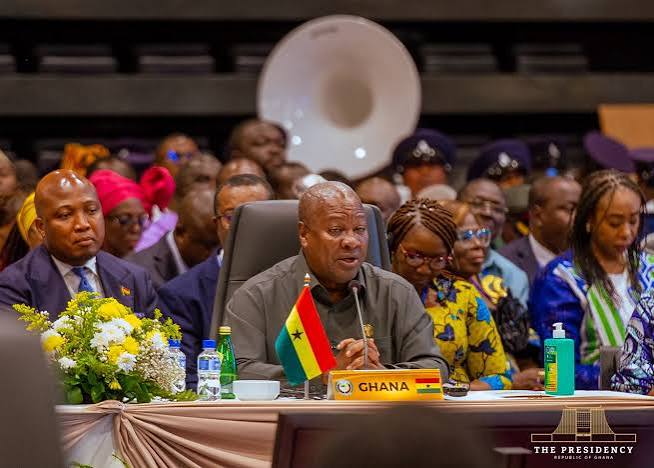

President John Dramani Mahama has called on the African Union to take urgent and decisive action over recurring xenophobic attacks targeting African nationals in South Africa, warning that the continued violence poses a serious threat to the principles of African unity, regional solidarity and the broader vision of continental integration.
The President made the appeal during a high level meeting with the Chairperson of the African Union Commission, His Excellency Mahamoud Ali Youssouf, at the Jubilee House in Accra on Wednesday, July 22, where he raised concerns about the growing humanitarian and diplomatic consequences of attacks against foreign African communities living in South Africa.

President Mahama argued that the issue has moved beyond isolated incidents involving individual countries and has become a continental challenge requiring collective attention from the African Union. He stressed that silence or limited intervention could undermine decades of efforts aimed at building stronger bonds among African nations through economic cooperation, free movement and shared identity.

According to the President, Ghana has already suffered significant financial and logistical costs as a result of efforts to protect and evacuate its citizens affected by the attacks. He revealed that government had been compelled to organise charter flights to bring Ghanaian nationals back home while providing financial support to assist their reintegration into society.

“At a very high cost to us, we had to charter planes to go to South Africa to evacuate our citizens. We operated three charter flights, and we are operating another three because there are still about 900 who have signed up to come back home,” President Mahama stated.
He explained that beyond transportation arrangements, Ghana has also provided reintegration assistance, including allowances and other support measures, to help returning citizens rebuild their lives after experiencing displacement and hardship.

President Mahama maintained that the scale of the crisis justified placing the matter before the African Union as a continental priority, particularly because xenophobic violence against Africans living in another African country directly contradicts the principles of solidarity and unity that underpin the organisation.
“I think that the AU should take an interest in this issue because it has the potential to wreck everything that we have worked for in terms of African integration and solidarity. We’re hoping to put it on the agenda of the next AU meeting,” he said.

The President described the experiences of countries whose citizens have been affected by xenophobic attacks as deeply traumatic, arguing that the consequences extend beyond immediate victims and create diplomatic tensions among African states.

“The countries that have been victims of these xenophobic attacks, it has been very traumatic. It sets all of us back,” he noted.
President Mahama also expressed concern about what he described as an insufficient response from South African authorities in addressing the attacks and holding perpetrators accountable. He revealed that Ghana had lost two citizens through the violence and questioned why individuals allegedly promoting hostility against foreign nationals appeared to operate without facing adequate consequences.
“We lost two of our citizens who have been killed. It doesn’t appear the South African authorities are responding to the magnitude that one would expect them to do. The persons who are fanning these attacks are known, and they have been left free to do what they want to do. They are doing it with impunity,” he stated.
The President’s comments come amid renewed diplomatic engagement between Ghana and South Africa over the matter. He disclosed that South African President Cyril Ramaphosa had recently sent a delegation to Accra to discuss the concerns raised by the Ghanaian government and explore possible solutions.
President Mahama said the engagement was necessary because unresolved tensions of this nature cannot be addressed through silence or avoidance. He argued that confronting difficult issues openly provides an opportunity for accountability, dialogue and lasting solutions.
“Sometimes these things happen, and we want to sweep them under the carpet, but when we do that, we do not cure what the problem is,” he said.
The Ghanaian leader emphasised that raising concerns over xenophobic attacks should not be interpreted as hostility towards South Africa or an attempt to damage bilateral relations. Instead, he explained that Ghana’s position was motivated by the desire to encourage transparency, accountability and a stronger collective response from African governments.
“I told them that Ghana does not harbour any malice against South Africa, but we are raising it so it gives them the platform to explain what they are doing to the world,” President Mahama stated.
The intervention places renewed attention on one of the most sensitive challenges confronting African integration efforts. South Africa, as one of the continent’s largest economies and a major destination for African migrants, has repeatedly faced criticism over violent attacks against foreign nationals, particularly migrants from other African countries who are often blamed for economic difficulties such as unemployment and competition for resources.
The issue has historically generated diplomatic tensions between South Africa and other African countries, with governments demanding stronger protection for their citizens and greater accountability for individuals involved in violent attacks.
For Ghana, the latest concerns represent both a humanitarian and diplomatic challenge. The country has long maintained strong historical and economic ties with South Africa, while thousands of Ghanaians continue to live, work and operate businesses there. Any deterioration in relations could therefore have broader implications for trade, migration and regional cooperation.
President Mahama’s appeal to the African Union signals a push for a continental approach rather than isolated national responses. His position reflects the argument that protecting African citizens across borders must become a shared responsibility if the vision of a united and integrated Africa is to become a reality.
As the matter moves toward possible consideration at the next African Union meeting, attention will focus on whether the continental body can develop stronger mechanisms to address xenophobia, protect migrant communities and reinforce the ideals of African brotherhood that have guided regional cooperation for decades.

