
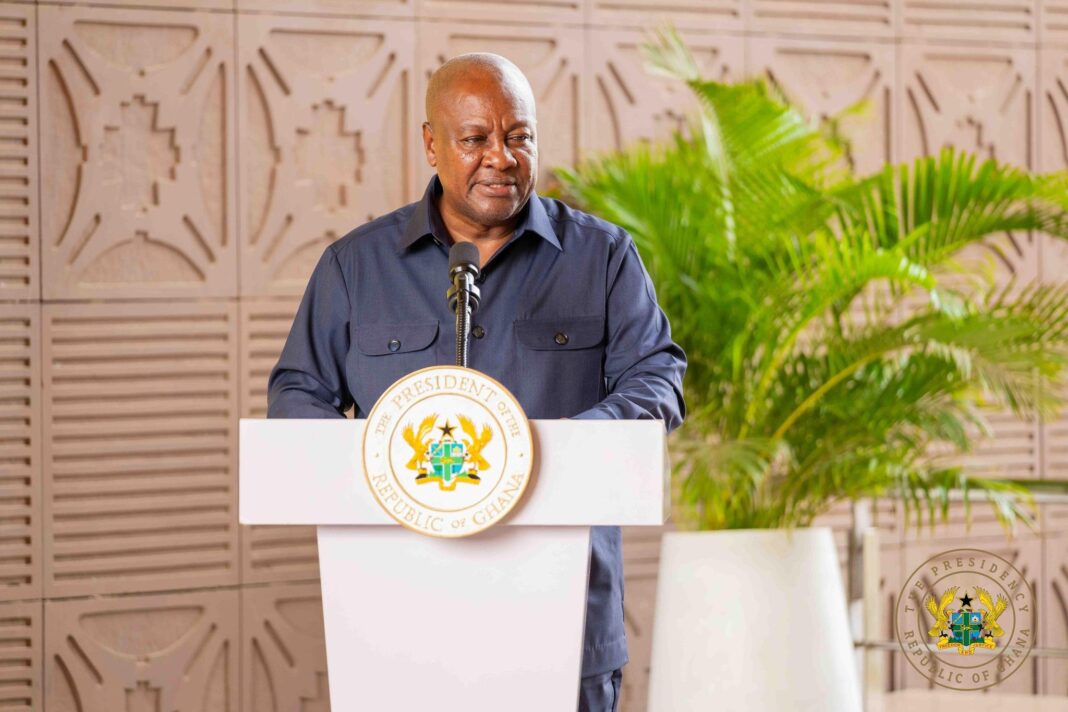

President John Dramani Mahama has taken a significant constitutional step towards strengthening Ghana’s highest court by nominating two distinguished Court of Appeal judges together with a respected former President of the Ghana Bar Association for appointment to the Supreme Court. Should Parliament approve the nominations, the country’s apex court will expand its membership from eighteen to twenty one justices, marking an important development in Ghana’s judicial system and reinforcing the capacity of the nation’s highest court to determine constitutional, civil and criminal matters of national importance.
The nominations, announced in accordance with the provisions of the 1992 Constitution, reflect one of the President’s most consequential constitutional responsibilities. Acting in consultation with the Judicial Council, President Mahama has nominated Justice Sophia Rosetta Bernasko Essah, Justice Edward Amoako Asante and eminent private legal practitioner Tony Forson for elevation to the Supreme Court. Their appointments remain subject to parliamentary scrutiny and approval before they can formally assume office.

The decision represents more than the routine filling of judicial vacancies. It underscores an effort to deepen the intellectual strength, institutional diversity and adjudicative capacity of the Supreme Court at a time when Ghana continues to witness increasing constitutional litigation, complex commercial disputes, electoral petitions and significant public interest cases requiring authoritative judicial determination.

Justice Edward Amoako Asante enters the nomination process with an exceptional judicial pedigree that extends well beyond Ghana’s national courts. His distinguished tenure as President of the ECOWAS Court of Justice placed him at the forefront of regional jurisprudence, where he presided over landmark cases involving human rights, regional integration and the interpretation of Community law. His return to the Court of Appeal further enriched Ghana’s Judiciary with international judicial expertise, making his nomination widely regarded as a recognition of decades of distinguished service to both Ghanaian and regional justice.

Justice Sophia Rosetta Bernasko Essah similarly brings substantial judicial experience acquired through years of service within Ghana’s superior courts. Her work on the Court of Appeal has contributed to the development of Ghanaian jurisprudence across numerous areas of the law, earning professional respect for her legal scholarship, judicial temperament and commitment to the impartial administration of justice. Her elevation would further strengthen female representation at the country’s highest judicial institution while adding another experienced appellate jurist to the Supreme Court bench.
Completing the list of nominees is Tony Forson, one of Ghana’s most accomplished legal practitioners and a former President of the Ghana Bar Association. Unlike the two judicial nominees, Mr Forson arrives from private legal practice, offering a perspective shaped by decades of courtroom advocacy, legal advisory work and leadership within the legal profession. His presidency of the Ghana Bar Association placed him at the centre of national conversations concerning constitutional governance, judicial independence, legal reforms and the protection of the rule of law. His nomination reflects the longstanding constitutional tradition of appointing distinguished legal practitioners alongside career judges to enrich the Supreme Court with diverse professional experience.

The nominations now proceed to Parliament’s Appointments Committee, where each nominee will undergo rigorous public vetting. Members of Parliament are expected to examine their legal qualifications, judicial philosophy, professional integrity, constitutional understanding and overall suitability for service on Ghana’s highest court. Following the hearings, the Committee will submit its report and recommendations to the full House, which will determine whether to approve the appointments.
Upon receiving parliamentary endorsement, the nominees will be sworn into office by President Mahama before officially joining the Supreme Court as Justices of the Republic of Ghana.

The importance of these appointments extends well beyond the careers of the individual nominees. The Supreme Court occupies the pinnacle of Ghana’s judicial hierarchy and serves as the ultimate guardian of the Constitution. It possesses exclusive original jurisdiction over constitutional interpretation and enforcement, exercises final appellate authority in both civil and criminal litigation and determines presidential election petitions alongside other disputes carrying profound constitutional significance. Every decision delivered by the Court shapes the interpretation of Ghana’s laws, influences public policy and establishes binding legal precedents for lower courts throughout the country.

Expanding the composition of the Supreme Court from eighteen to twenty one justices is expected to enhance the institution’s ability to manage an increasingly demanding caseload. As constitutional petitions, commercial litigation, human rights cases and election related disputes continue to grow in both complexity and volume, a larger bench is likely to improve judicial efficiency, reduce delays in the hearing of appeals and strengthen the Court’s capacity to deliver timely and authoritative judgments.
Historically, appointments to Ghana’s Supreme Court have always carried considerable constitutional and political significance because the institution functions as the final interpreter of the nation’s supreme law. The Court has delivered landmark judgments that have shaped presidential election disputes, clarified constitutional provisions, strengthened democratic governance, protected fundamental human rights and defined the limits of executive and legislative authority. Every appointment therefore contributes to the long term evolution of Ghana’s constitutional democracy and the continued development of its legal system.
President Mahama’s latest nominations consequently represent a pivotal moment in the country’s judicial history. By combining the extensive appellate experience of two accomplished judges with the practical expertise of one of Ghana’s most respected legal practitioners, the nominations seek to reinforce the intellectual depth, institutional resilience and constitutional authority of the Supreme Court. If Parliament grants its approval, the expanded bench will not only become one of the largest in the history of the Fourth Republic but will also be better positioned to uphold the Constitution, protect the rule of law and strengthen public confidence in Ghana’s independent Judiciary for many years to come.

