
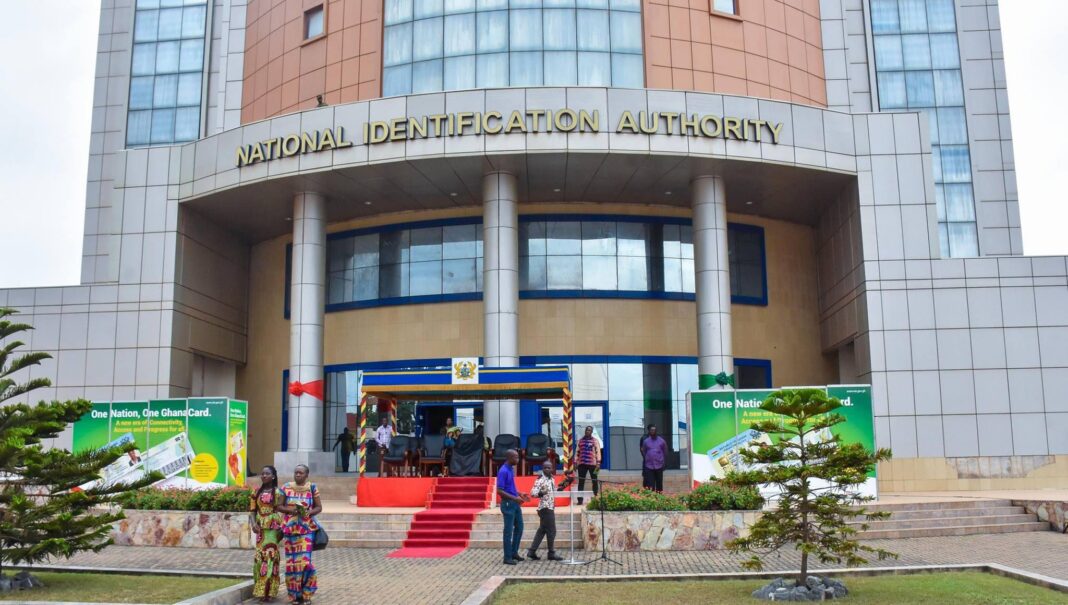

Ghana has entered a new phase in its national identification system following the enforcement of an amended legal framework that prohibits organisations and individuals from relying on photocopies or simple visual inspection of the Ghana Card as a means of verifying identity during transactions.
The National Identification Authority has announced that biometric authentication has now become the legally recognised and compulsory method for confirming the identity of Ghana Card holders, marking a significant transformation in how personal identification is validated across the country.

The Executive Secretary of the National Identification Authority, Yayra Koku, disclosed that the new requirement follows the coming into force of amendments to the National Identity Register Regulations, a development that effectively ends the widespread practice where institutions request photocopies of the Ghana Card or merely examine the physical card before providing services.

In a public statement issued on Wednesday, Mr Koku stressed that biometric verification is now mandatory and represents the official pathway through which institutions must authenticate the identity of individuals engaging in formal transactions. He warned that any organisation that continues to rely on prohibited methods of identification verification would be acting in violation of the law and could face significant legal consequences.

According to the NIA Executive Secretary, institutions that fail to comply with the amended regulations could face financial penalties ranging from a minimum of 500 penalty units to as high as 2,000 penalty units upon summary conviction. He further explained that individuals who breach the directive could also be subjected to penalties ranging between 50 and 500 penalty units depending on the circumstances of the violation.
The enforcement of this regulation represents a major milestone in Ghana’s digital identity transformation agenda because it moves the country away from traditional paper based verification methods and toward a more secure technology driven identification framework.

For many years, photocopying and manual inspection of identification documents have been common practices across financial institutions, government agencies, telecommunications companies, businesses and service providers. However, these methods have increasingly raised concerns regarding identity fraud, unauthorised duplication of personal information and the misuse of citizens’ identity records.
The introduction of mandatory biometric authentication seeks to address these challenges by ensuring that identity verification is directly connected to an individual’s unique biological characteristics, including fingerprints and other biometric features captured within the national identification database. The system is designed to provide greater certainty that the person presenting an identity credential is the legitimate owner of that identity.

Mr Koku explained that the legal change became effective after the amendment to Legislative Instrument 2111 completed the necessary parliamentary processes and was formally gazetted on Wednesday, July 15, 2026. The amendment, according to the NIA, provides the legal foundation for enforcing biometric verification as the primary mechanism for confirming Ghana Card identities during transactions.

The announcement places additional responsibility on public institutions, private businesses and service providers that depend on identity verification processes. Banks, telecommunications operators, insurance companies, government agencies and other organisations will now be required to integrate their systems with the NIA’s official verification platform rather than depending on physical copies or manual checks of identity cards.
Mr Koku encouraged institutions that require identity authentication services to begin the process of connecting to the NIA Identity Verification Platform. He explained that organisations can apply for onboarding onto the system through the Authority’s official channels to ensure compliance with the new legal requirements.
The NIA Executive Secretary also indicated that the Minister responsible for the National Identification Authority would soon provide additional details regarding the enforcement measures, implementation procedures and steps being taken to support institutions transitioning to the new verification regime.
The policy shift carries significant implications for Ghana’s broader digital economy ambitions. A reliable biometric identification system is considered a critical foundation for expanding digital financial services, strengthening public service delivery, improving security systems and reducing fraudulent activities associated with identity misuse.
The move also aligns Ghana with international trends where countries are increasingly adopting digital identity ecosystems that allow citizens to securely access essential services without depending on vulnerable paper based documentation. By strengthening identity verification, governments can improve efficiency, enhance transparency and protect individuals from impersonation and identity related crimes.
However, the successful implementation of the new requirement will depend heavily on the readiness of institutions, accessibility of verification infrastructure and public awareness about the changes. Organisations will need to upgrade their systems, while citizens will require clear guidance on how the new process affects everyday transactions.
The enforcement of mandatory biometric verification therefore represents more than a regulatory adjustment. It marks a decisive step in Ghana’s ambition to build a trusted digital identity architecture where personal identification is protected, transactions are more secure and government services are delivered through modern technological systems.
As the new rules take effect, the Ghana Card is expected to evolve from being simply a physical identity document into a digitally authenticated national identity tool capable of supporting a more secure and efficient economy. The success of this transition will depend on effective enforcement, institutional cooperation and continued investment in Ghana’s digital identification infrastructure.

