
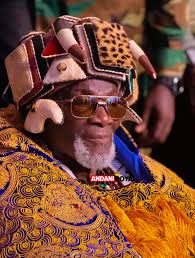

The ancient Gbewaa Palace in Yendi has witnessed one of the most solemn and historically significant moments in the modern history of the Dagbon Kingdom as the remains of His Royal Majesty Yaa Naa Abubakari II were laid to rest in accordance with centuries old Dagbon royal traditions.
Before the first rays of sunlight touched the royal grounds, silence descended upon the traditional seat of Dagbon as the final funeral rites of the 41st Yaa Naa were performed at the sacred royal mausoleum. The ceremony represented not only the physical departure of a monarch but also the closing chapter of a reign that became internationally recognised for restoring peace, reconciliation and stability to one of Ghana’s oldest traditional kingdoms.

The burial, conducted at dawn in line with deeply preserved Dagbon customs, was supervised by the Kuga Naa, the traditional father and chief kingmaker of Dagbon, together with the Dagbon Consecrated Council of Elders. The sacred proceedings followed a carefully guarded royal protocol that has governed the transition of Dagbon overlords across generations.

As the body of the late monarch was conveyed to the palace for the final rituals, the powerful drums that had announced the mourning period across Yendi fell into a quieter rhythm. The sound of celebration associated with a reigning Yaa Naa was replaced by a subdued ceremonial expression of grief, respect and remembrance.

The traditional announcement of the passing of the King, the purification of the palace and the final preparations for burial were carried out according to Dagbon customs. Chiefs whose traditional authority flows directly from the Yaa Naa’s throne gathered at the forecourt of the Gbewaa Palace to honour the departed ruler, while royal drummers solemnly recounted his lineage and historical place within the Dagbon royal succession.
Unlike public celebrations that accompany royal festivals, the burial itself was conducted privately within the royal mausoleum, with only selected elders, family members and traditional custodians permitted to witness the final moments of the sacred rites.

The passing and burial of Yaa Naa Abubakari II represent a defining moment in Ghana’s traditional history because his ascension to the Dagbon skin in January 2019 came after one of the longest and most painful chieftaincy conflicts in the country’s history. His installation followed years of mediation by the Committee of Eminent Chiefs, led by respected traditional authorities, which helped create a pathway towards reconciliation between the Andani and Abudu royal gates after decades of division.
When he assumed the throne, Yaa Naa Abubakari II inherited a kingdom still recovering from the wounds of the 2002 Dagbon crisis. His reign therefore became closely associated with rebuilding confidence, restoring traditional authority and strengthening unity among communities that had endured years of tension.

Beyond his role as a custodian of Dagbon culture, the late monarch was widely regarded as a symbol of reconciliation whose leadership encouraged cooperation between traditional institutions, government and development partners. The Gbewaa Palace described him as a peacemaker and unifier whose reign restored dignity, stability and greater national recognition to Dagbon.

His leadership also coincided with renewed attention towards development initiatives in Dagbon, including efforts to preserve and modernise the historic Gbewaa Palace, which remains the spiritual and political centre of the kingdom.
The funeral ceremonies attracted traditional leaders, political figures and dignitaries from across Ghana who joined residents of Yendi to honour a monarch whose reign became synonymous with healing after conflict.
President John Dramani Mahama’s government described the death of Yaa Naa Abubakari II as a significant national loss, extending condolences to the Royal Family, the people of Dagbon and Ghanaians across the country. The government stated that the late King would be remembered for his wisdom, statesmanship and commitment to peace, unity and national development.
The government further noted that his reign strengthened cooperation between traditional authorities and the state, creating a stronger foundation for development within Dagbon and beyond.
The New Patriotic Party’s presidential candidate, Dr Mahamudu Bawumia, also expressed sorrow over the passing of the revered monarch, describing his death as a painful loss to Dagbon and Ghana. He praised the late Yaa Naa for guiding the kingdom through one of its most difficult periods and credited him with helping unite families, repair social divisions and promote development.
Dr Bawumia said his personal encounters with the late King during his time as Vice President and presidential candidate allowed him to benefit from the monarch’s wisdom, describing visits to the Gbewaa Palace as moments of honour and learning.
With the burial completed, Dagbon now enters another important constitutional and traditional phase. The kingdom is expected to proceed with arrangements for succession, including the installation of a Regent who will oversee the affairs of Dagbon with the guidance of the Council of Elders until the appropriate traditional processes for selecting and enskinning a new Yaa Naa are completed.
For Yendi and the wider Dagbon Kingdom, the mourning period is not only a time of grief but also a moment of reflection on the extraordinary journey of a ruler who inherited a divided kingdom and left behind a legacy defined by peace, restoration and reconciliation.
Yaa Naa Abubakari II’s reign will remain recorded as a historic chapter in Ghana’s traditional leadership story, a period when the ancient throne of Dagbon became a symbol of national healing after decades of uncertainty.

