
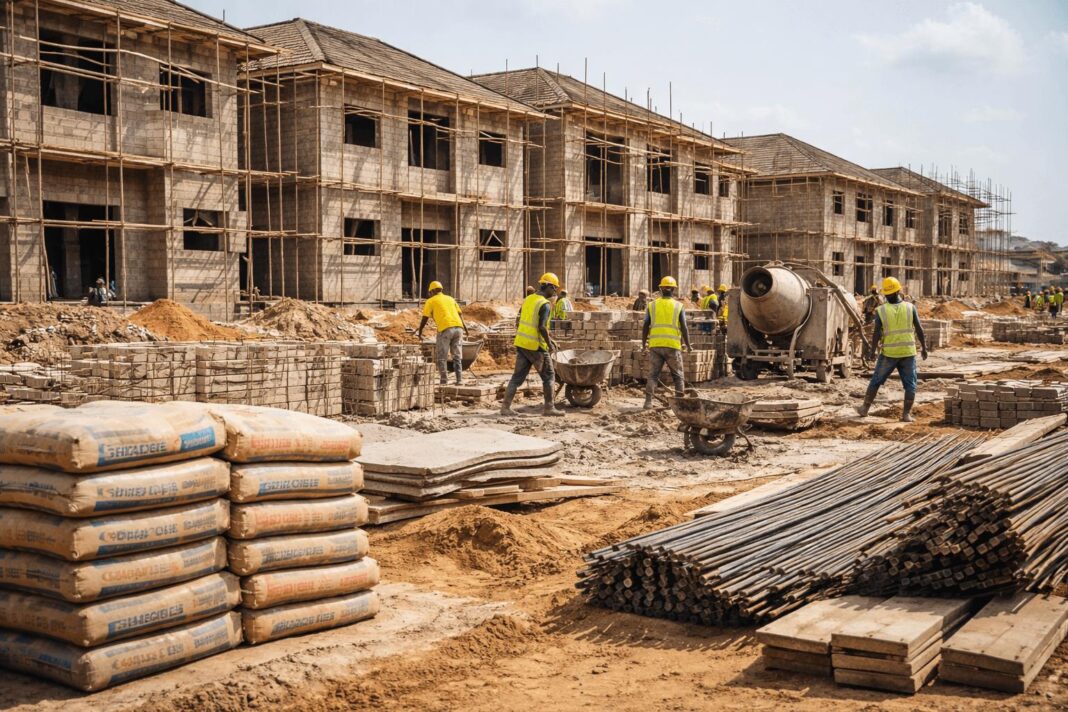

The cost of constructing buildings in Ghana registered a modest increase in May 2026, signalling renewed price pressures within the country’s construction industry after several months of relative stability. Fresh data released by the Ghana Statistical Service revealed that the Prime Building Cost Index recorded a year on year inflation rate of 2.7 per cent in May 2026, rising from 2.2 per cent in April and marking the second consecutive monthly acceleration in construction related inflation. Although the increase remains historically moderate, it represents an important development for an industry that serves as a key barometer of economic activity, private investment and public infrastructure expansion.
The latest figures indicate that while Ghana’s construction sector continues to enjoy considerably lower inflationary pressures than those experienced a year ago, the gradual resurgence in building costs deserves close attention from policymakers, developers, contractors and prospective homeowners. In May 2025, construction inflation stood at approximately 22 per cent, highlighting the remarkable progress achieved in stabilising prices across the industry over the past twelve months. The current rate of 2.7 per cent therefore represents a substantial improvement in cost conditions despite the recent upward movement.

The Prime Building Cost Index serves as Ghana’s principal measure of changes in the prices of materials, labour and equipment used in the construction of buildings. As one of the country’s most closely watched economic indicators, the index provides valuable insight into the affordability of housing, the viability of commercial developments and the cost effectiveness of public infrastructure projects. Any movement in the index has direct implications for investors, financial institutions, government agencies and ordinary citizens seeking to build homes or expand businesses.

Data from the Ghana Statistical Service showed that overall construction input prices increased by 1.4 per cent between April and May 2026. While this monthly rise may appear modest, it suggests that cost pressures remain present within several segments of the construction supply chain. The increase comes at a time when Ghana’s broader inflation environment remains relatively subdued, with national consumer inflation standing at 3.7 per cent in May 2026.

Building materials remained the dominant source of inflation within the sector. Material prices recorded a year on year inflation rate of 3.5 per cent in May, up from 2.4 per cent in April. Given that materials constitute more than three quarters of the Prime Building Cost Index basket, their influence on overall construction inflation remains decisive. Virtually the entire increase in headline building inflation was attributed to developments within this category.
The importance of material costs cannot be overstated. In Ghana’s construction sector, materials such as cement, steel, roofing products, plumbing accessories, electrical fittings and finishing components account for the largest share of project expenditure. Even relatively small movements in these prices can significantly affect the overall cost of housing developments, office complexes, schools, hospitals and transport infrastructure.

Among the various categories of construction inputs, plumbing materials emerged as the fastest growing component, recording an annual inflation rate of 22.8 per cent. This sharp increase reflects sustained pressures within imported building components and specialised construction supplies. Rising plumbing costs have become a particular concern for developers, especially in residential and commercial projects where water systems form an essential part of construction expenditure.
Roofing materials also experienced notable price growth, with roofing sheets registering inflation of 19.9 per cent. Roofing remains one of the most expensive stages of building development in Ghana and any significant increase in roofing costs can substantially raise project budgets. The latest figures therefore suggest that developers may continue to face elevated costs when completing residential and industrial structures.

Glazing materials recorded the third highest inflation rate at 18.5 per cent. This category includes windows, glass panels and related fittings which have become increasingly important in modern commercial and residential architecture. Rising glazing costs could affect the affordability of high quality building finishes, particularly within urban real estate developments.

Despite these increases, several major construction inputs recorded encouraging price reductions. Cement, which remains one of the most widely used materials in the industry, posted an annual inflation rate of negative 14.5 per cent. Steel prices also declined by 8.1 per cent. These decreases provided substantial relief for contractors and property developers because cement and steel constitute the structural foundation of most construction projects.
The reduction in cement and steel prices carries significant implications for Ghana’s housing market. Lower costs for these essential inputs can help offset increases in specialised materials and contribute to maintaining affordability across a wide range of building projects. For many households planning to build homes, the continued decline in cement and steel prices represents one of the most positive developments within the construction sector.
Labour costs also contributed to easing inflationary pressures. Labour inflation fell into negative territory at minus 2.0 per cent year on year, compared with positive growth of 1.0 per cent recorded in April. This decline helped cushion the overall increase in construction costs and prevented building inflation from rising more sharply.
The fall in labour inflation may reflect improved labour availability, changing market conditions or adjustments within the construction employment landscape. While lower labour costs can benefit project budgets, they also raise important questions about wage growth and employment conditions within the sector.
Another noteworthy development emerged from the plant category, which includes machinery, equipment and small construction tools. Inflation within this segment accelerated dramatically to 9.8 per cent from 4.7 per cent recorded in April. On a monthly basis, equipment related costs rose by 4.7 per cent, making it the fastest growing major category within the index.
The rapid increase in equipment costs highlights the continuing challenges associated with importing machinery and maintaining specialised construction tools. Given Ghana’s growing emphasis on infrastructure development and industrial expansion, rising equipment costs could become an increasingly important factor influencing project budgets.
Beyond the immediate figures, the latest data carry broader economic significance. Construction serves as a critical driver of employment, investment and economic growth. Movements in building costs influence decisions by households seeking mortgages, developers planning residential estates, businesses constructing factories and government agencies implementing infrastructure programmes.
Historically, periods of declining construction inflation have often coincided with increased building activity because developers are better able to forecast costs and manage project budgets. The sharp reduction in inflation from the levels observed in 2025 has therefore created a more predictable operating environment for the industry.
The improvement is particularly important for Ghana’s housing sector, which continues to face substantial demand pressures. Lower and more stable construction inflation can encourage greater investment in affordable housing projects while supporting efforts to reduce the country’s housing deficit.
For government, the current environment presents a strategic opportunity. Lower construction inflation can enhance the value obtained from public expenditure on roads, schools, hospitals and other infrastructure projects. Every percentage point reduction in construction costs potentially allows public funds to support a greater volume of development projects.
The data also arrive at a time when Ghana’s broader economy is experiencing relatively subdued inflation compared with recent years. Consumer inflation, producer inflation and building inflation have all remained significantly below the elevated levels recorded during earlier periods of economic volatility.
Economic analysts note that sustained stability within the construction sector can generate positive spillover effects across multiple industries, including manufacturing, transport, real estate, financial services and retail trade. As a result, trends within the Prime Building Cost Index often provide valuable signals regarding future economic activity.
The Ghana Statistical Service observed that despite the recent increase, the broader trajectory of construction inflation remains favourable. Compared with the exceptionally high inflation rates recorded during 2025, current conditions represent a significant improvement in cost stability and market predictability.
For households contemplating new building projects, the present environment offers a window of opportunity. The continued decline in cement and steel prices alongside relatively low overall inflation suggests that many projects can still be undertaken under more favourable conditions than were available a year ago.
Businesses and developers are therefore being encouraged to secure current prices where possible and advance construction plans before further cost increases emerge. At the same time, government agencies may find it advantageous to accelerate key infrastructure programmes while building inflation remains comparatively low by historical standards.
Ultimately, the May 2026 Prime Building Cost Index tells a story of cautious optimism. While construction inflation has edged upward for a second consecutive month, the sector remains far more stable than it was a year earlier. The resurgence in certain material categories warrants monitoring, yet the continued decline in cement, steel and labour costs provides an important counterbalance. For an industry that underpins housing delivery, infrastructure expansion and economic development, the latest figures suggest that Ghana’s construction sector remains on a considerably stronger footing than it occupied just twelve months ago, even as new cost pressures begin to emerge.

