
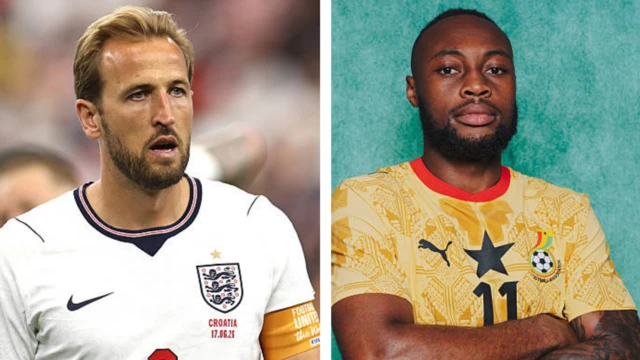

England and Ghana are preparing for one of the most anticipated matches of the group phase of the 2026 FIFA World Cup, with the encounter attracting attention not only because of what is at stake on the field but also because of the deep historical connections that bind both countries.
Scheduled for Tuesday, June 23, at Boston Stadium, internationally recognised as Gillette Stadium, the Group L contest has generated intense discussion among supporters and historians alike, transforming what would ordinarily be a football fixture into a meeting that evokes memories stretching back more than a century.

While tactical considerations, Thomas Partey’s expected influence and pre match narratives have dominated sporting conversations, another question has increasingly captured public attention. Did England colonise Ghana?

The answer lies firmly within the pages of history.

Long before football brought both nations together on the global stage, the territory now known as Ghana experienced centuries of European commercial and political influence. Beginning in the fifteenth century, Portuguese merchants established trading posts along the coast, followed by Dutch and British interests that gradually expanded their presence within the region.
As competition among European powers intensified, Britain steadily consolidated its influence over the coastal territories. In 1874, the area formally became a British colony known as the Gold Coast, establishing direct colonial administration and laying the foundations for decades of British rule.

British authority expanded further following a series of military confrontations with the Ashanti Empire, one of the most powerful kingdoms in West Africa. Through successive campaigns and political arrangements, Britain extended control over the Northern Territories and British Togoland, bringing together territories that would eventually form modern Ghana.
For eighty three years, the Gold Coast remained under British administration, becoming one of Britain’s most important possessions in Africa because of its abundant natural resources, particularly gold and cocoa.

However, the twentieth century witnessed the rise of nationalist movements across the continent, and the Gold Coast emerged at the forefront of Africa’s struggle for self determination.

At the centre of that movement stood the visionary leader, Kwame Nkrumah, whose campaign for self government transformed the political destiny of the country and inspired liberation movements across Africa.
On March 6, 1957, history was made when Ghana secured independence from Britain, becoming the first sub Saharan African colony to free itself from European rule. The achievement resonated far beyond the country’s borders and marked a defining chapter in the global movement against colonialism.
The newly independent nation adopted the name Ghana, paying tribute to the ancient Ghana Empire, which flourished centuries earlier in West Africa and symbolised African pride and civilisation. The change represented a deliberate departure from the colonial designation of Gold Coast, a name derived largely from the region’s vast mineral wealth.
Nearly seven decades later, the descendants of both nations will once again meet, this time on football’s grandest stage.
Although England and Ghana do not share a longstanding football rivalry comparable to some of the sport’s traditional contests, every encounter between the two sides carries symbolic significance because of their intertwined histories.
For many supporters, the fixture represents more than ninety minutes of competition. It offers an opportunity to reflect on the transformation of relations between a former colonial power and one of Africa’s most influential nations.
On the sporting front, both countries understand the importance of securing a positive result in Group L.
England approach the encounter buoyed by a commanding 4 to 2 triumph over Croatia in their opening fixture, while Ghana commenced their campaign with a determined 1 to 0 victory over Panama, a result that reinforced belief within the Black Stars camp.
Victory for either side would place them in a strong position to advance to the knockout stages and potentially shape the destiny of Group L.
The atmosphere inside Gillette Stadium is expected to reflect the magnitude of the occasion, with thousands of supporters from both nations anticipated to create one of the most vibrant spectacles of the tournament.
Kick off is scheduled for 4:00 pm local time in Boston. Supporters in Ghana will follow proceedings from 8:00 pm Greenwich Mean Time, while audiences in the United Kingdom will watch from 9:00 pm British Summer Time.
Viewers across Ghana are expected to tune in through GTV and other local terrestrial networks, while supporters in the United States will be able to follow the action on FOX and Telemundo, with streaming services including Fubo and Peacock also providing coverage.
Yet regardless of the result, the meeting between England and Ghana serves as a reminder of how history and sport often intersect in unexpected ways.
What was once a relationship defined by colonial rule has evolved into one characterised by diplomacy, migration, commerce and cultural exchange. Football now provides another platform through which both nations engage, not as ruler and colony, but as equals competing on the world’s biggest stage.
As millions prepare to watch the match unfold, the significance extends beyond qualification scenarios and tactical battles. It represents a moment where history and modern identity converge, illustrating how nations once separated by power and empire can meet through sport, united by competition and mutual respect.
For Ghana, whose independence in 1957 altered the course of African history, and for England, whose colonial legacy continues to shape global conversations, the World Cup encounter in Boston offers more than a contest for points. It is a reflection of a shared past and a testament to how far both nations have travelled since the days when the Gold Coast was governed from London.
When the whistle blows inside Gillette Stadium, the players will focus solely on football. Yet behind every pass, tackle and goal will remain a historical narrative spanning centuries, reminding the world that some matches carry stories far greater than sport itself.

