
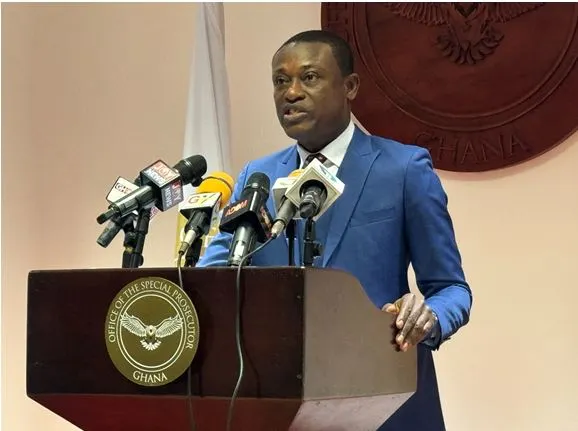

The Special Prosecutor, Kissi Agyebeng, has warned that sustained efforts to weaken, marginalise, or abolish the Office of the Special Prosecutor are steadily eroding Ghana’s fight against corruption and quietly advancing the interests of those who benefit from impunity. In the Office’s Half-Yearly Report for 2025, he argued that the national anti-corruption drive would be far more effective if the OSP were allowed to function without what he described as constant and unnecessary battles over its very existence.
According to Mr Agyebeng, repeated attempts to extinguish the mandate and powers of the OSP serve no legitimate national purpose and instead dilute institutional accountability. He stressed that the anti-corruption effort would gain real traction only if the Office were spared the continual struggle to justify its survival, noting that these distractions weaken enforcement capacity and slow momentum at critical moments.

He expressed particular concern that these threats are not limited to individuals seeking to escape scrutiny, but also originate from within the state itself, including certain public officials and Members of Parliament. In his view, such actions cannot credibly be framed as serving the public interest, since undermining the OSP ultimately strengthens corruption by allowing misconduct to go unpunished and normalising institutional vulnerability.

These concerns were amplified by events in the second half of 2025, which the Special Prosecutor described as a period of extreme resistance against the Office. In the Half-Yearly Report covering July to December, he detailed what he characterised as a coordinated and unfair existential threat aimed at terminating the OSP’s independence through legislative means. The report portrays an anti-corruption institution under sustained pressure from actors who feel directly threatened by accountability.

Central to this confrontation was a Private Member’s Bill introduced in Parliament seeking to abolish the OSP and subsume its functions under the Attorney-General’s Department. Proponents of the bill argued that the Office had become a drain on national resources and pointed to institutional friction and jurisdictional overlap as justification. However, the bill was withdrawn following direct intervention by President John Dramani Mahama, a move the Special Prosecutor described as decisive and consequential.
Mr Agyebeng commended the President’s action, noting that it preserved what he called the gold standard of independent anti-corruption enforcement. He observed that the withdrawal reflected a collective understanding that the Attorney-General, as a member of Cabinet and chief legal adviser to the Government, is structurally ill-suited to investigate and prosecute members of an administration of which he is part. In his assessment, merging prosecutorial power with executive loyalty would severely compromise the credibility of anti-corruption efforts.

The report also mounted a firm rebuttal to claims that the OSP has failed to deliver value relative to its operational cost. It dismissed the memorandum supporting the withdrawn bill as a series of bare assertions made without any empirical evaluation of the Office’s actual performance. While sponsors of the bill contended that consolidating authority under the Attorney-General would improve efficiency and coordination, the OSP countered that no evidence was presented to show how a Cabinet member could more effectively investigate corruption within their own government.
Mr Agyebeng maintained that a careful examination of the arguments advanced for abolishing the Office reveals that they are fundamentally unfair and disconnected from the demonstrable impact of the OSP since its establishment. He added that the Office does not shy away from scrutiny, pointing to its consistent appearance before parliamentary oversight committees as evidence of transparency and institutional openness.

Beyond defending the OSP’s continued existence, the Special Prosecutor used the report to press for deeper structural reform of Ghana’s anti-corruption architecture. He urged the state to adopt recommendations of the Constitution Review Commission, including the establishment of a fully independent constitutional body with exclusive authority to investigate and prosecute corruption-related offences. Such an institution, he suggested, could either absorb or replace the OSP, but must be insulated from political control, operate independently of the Attorney-General and Minister of Justice, and be supported by robust legal powers and adequate resources. Any reform short of this, he warned, would render the fight against corruption largely illusory.

To underscore the Office’s impact, the report highlighted a series of interventions that have delivered significant savings to the state. These include the 2020 corruption risk assessment of the Agyapa Royalties transaction, which prevented potential losses running into billions of dollars and safeguarded national sovereignty over natural resources. It also referenced the 2022 investigation into customs advance rulings, which eliminated discretionary discounts on import valuations and shut down avenues for abuse, saving the country millions of cedis.
Further achievements cited include reforms to auction sales at the ports through the introduction of an electronic auction system in 2023, which increased monthly auction revenue by an average of twelve percent and added millions of cedis to state coffers. The report also pointed to the 2023 to 2025 investigation into procurement contracts awarded by the Ghana Revenue Authority and the Ministry of Finance to Strategic Mobilisation Ghana Limited, which resulted in the cancellation of the contracts and savings exceeding five point seven billion cedis. Additionally, a 2025 corruption risk assessment of disinfection services at Ghana’s ports of entry was credited with saving the Republic an estimated three hundred and forty five million cedis.
In closing, the Special Prosecutor concluded that the resistance encountered in late 2025 was not accidental but a direct response to the Office’s growing effectiveness. In his assessment, the pushback reflects discomfort among those whose interests are threatened by accountability, reinforcing rather than undermining the case for a strong, independent, and well-resourced anti-corruption institution in Ghana.
SOURCE: Myjoyonline

